
You raised a family in this house.
Deciding what happens to it deserves more than a listing appointment. Start with whether this is even the right year to move.
Where this starts
Most people think the first question is whether to sell first or buy first. It isn't.
The first question is whether it is time to move at all. Sometimes the answer is no, and I will tell you that. There is no fee for finding out, and I would rather you make this decision once, on your timeline, than make it twice.
The families I work with have usually been in the same house for twenty five years or more. The kids grew up in it. Most of the holidays happened in it. That history is real, and it is the reason this decision gets postponed for years. It is not a math problem you have been failing to solve. It is harder than that.
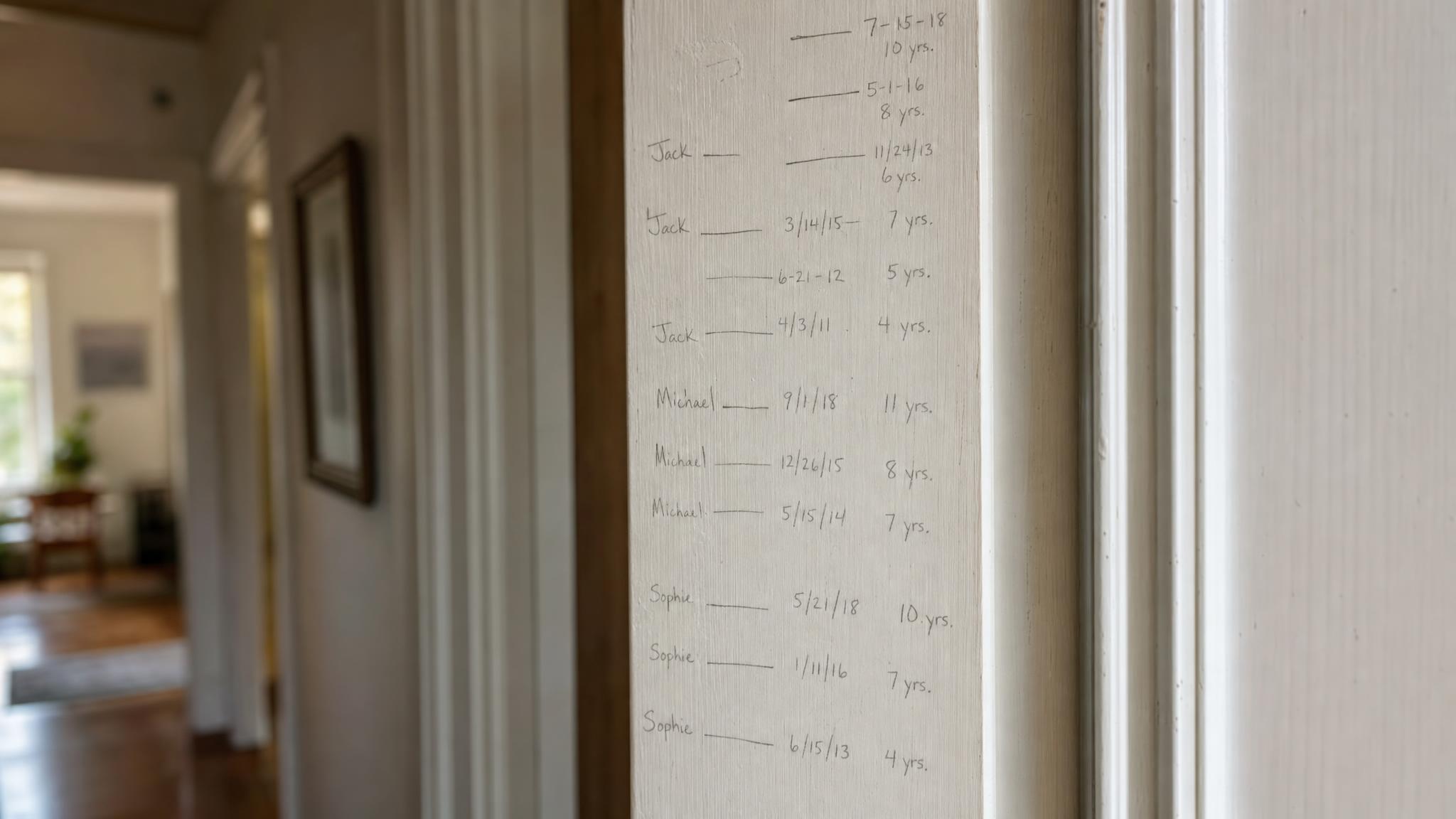
Every house I sell has a door frame like this one somewhere in it. I photograph them before the painters come.
The number people want first
What would actually be left over?
Almost every conversation starts here, and almost nobody has run it. Put in your own numbers. Nothing is sent anywhere and nobody is contacted.
Cash from the sale Next place Left over
This is an estimate to get you oriented, not a quote or an appraisal. Your actual costs depend on the condition of the house, what is negotiated, and what the market is doing when you list. It also ignores taxes, which for a house held since the eighties or nineties can matter. That is a conversation for your CPA and I will flag it early.
A question that comes up next
Should some of it go into a rental?
If the number above is larger than you expected, this is usually the next thing families ask. It is a fair question and it deserves a real answer rather than an enthusiastic one.
Here is the part most people are not told. At today's rates, a townhome in Utah County bought with twenty five percent down generally does not cover its own costs in the early years. Once you add the loan payment, property taxes, landlord insurance, HOA dues, and an honest reserve for repairs, the monthly total usually lands above what the place rents for. It can still be a sound long-term decision. It is not monthly income, and anyone who tells you it is has not run it.
There are also depreciation rules that can matter a great deal, including cost segregation studies and the bonus depreciation rules Congress made permanent in 2025. Whether any of it reduces your tax bill depends on passive activity rules that catch most retired owners off guard. That is your CPA's call, not mine. What I will do is make sure the question gets asked before you buy rather than in April.
Worth a conversation if
- The money is genuinely surplus after your next home is bought and your income is covered
- You have a long enough horizon that early years of negative cash flow do not matter
- You already have a CPA and a financial advisor, or you want introductions to both
- An adult child needs housing and the property could serve two purposes at once
Probably not for you if
- These proceeds are what you are living on
- A bad year, a vacancy, or a large repair would put real pressure on you
- You would need this money back quickly, since property is slow to sell
- Nobody in the family wants to be a landlord, including at eighty
I am a real estate agent. I am not a financial advisor, an investment advisor, or a tax professional, and nothing here is a recommendation to buy anything. What I can do is run real numbers on a specific property so you are looking at facts instead of a general idea, and put you in a room with the professionals who should be making this call with you. If the numbers do not work, I will say so.
The second question people ask
How long does this actually take?
Six months to a year for most families. Here is where that time goes, and why the order matters more than the speed.
The row in gold is the one that surprises people. Emptying the house takes longer than selling it and has to start well before the sign goes up. Families who begin there get a calmer sale and more choice on the next place. Families who wait until they are under contract end up making decisions about their belongings in a hurry, which is how things get thrown away that should not have been.
The work
What we work through together
Two moves have to line up, and for most families a third conversation follows close behind.

Selling the house you have been in for decades
What it is worth, what is worth fixing before it lists, and what is not. I bring in the people who handle contents, estate sales, and the move itself, so you are not standing in the garage alone deciding what to do with it all.

Funding and buying the next place
If the house is paid off you have more freedom than most people assume, including ways to buy before you sell. We work out what the next place costs to run, not only what it costs to buy. Stairs, yard, taxes, insurance, HOA, and how many years you need it to work for you.

Your kids, if the timing is right
When equity from a long-held home starts moving, some of it often moves toward the next generation. Utah has first-time buyer programs your adult children may qualify for. I can walk them through what they qualify for while I am working with you.
Questions people ask me
Before you talk to anyone
Should we sell first or buy first?
It depends on whether you are carrying a mortgage and how much room you have to hold two payments for a stretch. If you own the house outright you have far more freedom than most people assume, including options that let you buy before you sell without a bridge loan. This is one of the first things we work out, because the answer sets the whole timeline.
What if we sell and then cannot find anything?
This is the fear that keeps most people in a house they have outgrown, and it is a reasonable one. Single-level and low-maintenance homes are thinner here than they should be. That is why I track that inventory directly rather than waiting for it to show up in a search alert, and why we start looking well before your house is listed. There are also ways to structure the sale that buy you time to move, including a rent-back from the buyer.
The house needs work. Do we have to fix it?
Some of it, rarely all of it. There is a short list of things that reliably return more than they cost in this market and a much longer list that does not. I will walk the house with you and tell you which is which, including when the honest answer is to sell it the way it stands.
What do we do with everything inside it?
This is the real work, and it takes longer than the sale does. Start it before you list, not after. I work with senior move managers and estate sale companies who do this for a living, and I make the introductions early enough that the timing actually holds.
Will we owe taxes on what we made on the house?
Possibly. Long-held Utah County homes have appreciated enough that the gain on a house bought in the eighties or nineties can run past what a married couple is able to exclude. Most agents never raise this. I am not your CPA and will not pretend to be, but I will flag it early enough for you to get a real answer from one, and I can introduce you to people who handle it well.
Can we get a mortgage in our seventies if we need one?
Age is not a factor lenders are allowed to consider. Retirement income, social security, and drawdowns from retirement accounts can all be counted toward qualifying, and there are products built for exactly this situation. If you are putting down a large amount from the sale, the loan you need is often small enough that this is easier than you expect.
Do we have to leave Utah County?
Usually not. Most people want the same ward, the same neighbors, and a shorter drive to the same grandkids, in a house that does not require a ladder. If the move is out of state to be near family, I have people I trust in most markets and I stay involved on this end.

About
John Busch IV
I grew up near Philadelphia, where rooting for the underdog comes naturally. My uncle Jerry owned a restaurant and tried more than a few other ventures. Listening to him talk about the risks, mistakes, and work behind them made me curious about how people build a life and what they do when it is time to change course.
Before real estate, I spent more than a decade in financial services and insurance. That background helps when a move involves more than a sale price: monthly costs, insurance, equity, taxes, and the question of what the house needs to provide next. I serve Utah and Salt Lake counties, with much of my work focused on families who are downsizing or relocating after many years in one home.
My wife, Lauren, and I were high school sweethearts. We have been married for more than 22 years and are raising nine kids in Mapleton. I know firsthand that a house can be part balance sheet, part storage unit, and part family history. All three deserve attention when it is time to move.
Start with a conversation
Fifteen minutes on the phone, or an hour at your kitchen table. You will not sign anything, and there is no next step unless you want one. If the answer is that this is not the year, that is a good outcome too.